

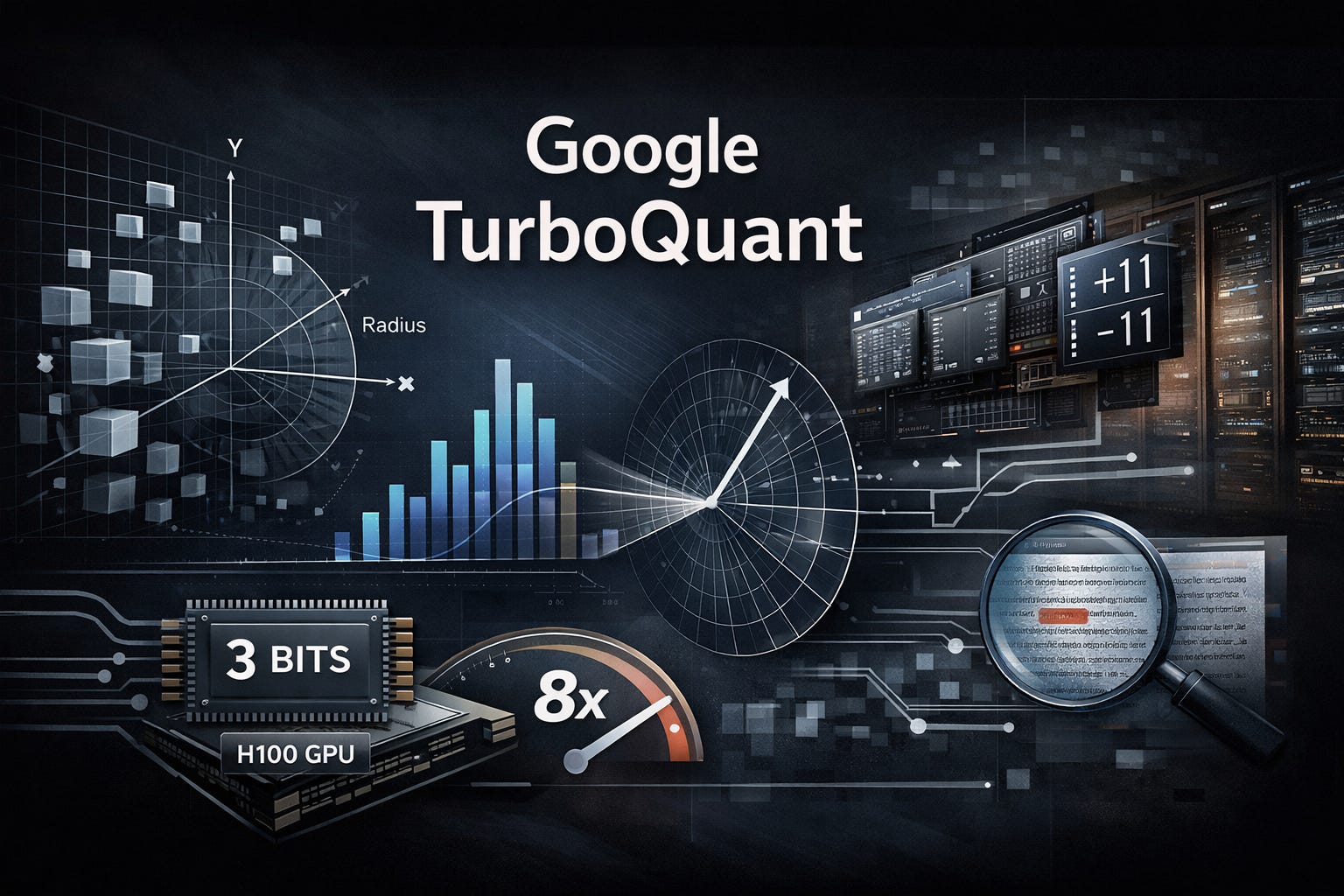
There is a particular kind of progress in computer science that happens not through brute force or capital expenditure, but through someone realizing that the problem was being framed wrong from the start. TurboQuant, published this week by Google Research and to be presented at ICLR 2026, belongs squarely in that category.
The setup is unglamorous but consequential: when a large language model processes a long document or a multi-turn conversation, it maintains a key-value cache — a running memory of all the attention states computed so far, so it doesn’t have to recompute them at every new token. This cache is the reason modern LLMs can handle long contexts at all. It is also, at scale, a catastrophic memory hog.
For a 70-billion-parameter model serving 512 concurrent requests at a 2,048-token prompt length, the KV cache alone can require over 512 GB of GPU memory — nearly four times the memory consumed by the model weights themselves. This is not a theoretical edge case. This is production reality for anyone running frontier models at scale today.
The Problem With the Problem
The standard response to this problem has been quantization: store each number with fewer bits. Instead of 16 bits per floating-point value, use 8, or 4, or even 2. But traditional quantization methods carry a hidden cost — they must compute and store per-block normalization constants in full precision to maintain numerical stability. These bookkeeping constants add 1 to 2 bits per number back onto the bill, partially negating the savings. The field has been running in place.
What TurboQuant’s authors identified is that this overhead isn’t a necessary cost of doing business. It’s a consequence of a geometric choice: representing vectors in Cartesian coordinates.
Technical aside: Standard quantization operates on vectors in Cartesian space — coordinates along X, Y, Z axes. The boundaries of each data block shift depending on the data itself, forcing the algorithm to store normalization constants so it knows how to interpret compressed values later. TurboQuant’s PolarQuant component converts vectors into polar coordinates instead: a radius (magnitude) and a set of angles (direction). The angular distribution in high-dimensional vectors is known, concentrated, and predictable — which means the normalization step is unnecessary. The coordinate grid’s boundaries are already fixed. Zero overhead, by design.
This is PolarQuant, presented at AISTATS 2026. It handles primary compression, using most of the available bits to capture the vector’s core magnitude and direction. But compression always introduces some error, and that residual error, left uncorrected, would degrade attention score computation — the mechanism by which the model decides what to attend to in its context.
One Bit to Rule the Residual
This is where QJL — the Quantized Johnson-Lindenstrauss component — enters. The Johnson-Lindenstrauss Transform is a classical result in linear algebra: it guarantees that high-dimensional data can be projected into a much lower-dimensional space while preserving the distances and relationships between points. QJL takes this transform and reduces the remaining error vector to a single sign bit: +1 or -1.
One bit. Zero memory overhead. And through a careful estimator that pairs this crude representation against the full-precision query vector during attention computation, the bias introduced by compression is eliminated.
The insight is almost perverse in its elegance: you don’t need to store a precise residual if you can construct an unbiased estimator that corrects for the imprecision at query time.
The combined system — PolarQuant for primary compression, QJL for error correction — is Google TurboQuant. Tested against LongBench, Needle In A Haystack, RULER, and L-Eval benchmarks using Gemma and Mistral as base models, the results are unambiguous:
6× memory reduction with performance statistically indistinguishable from the uncompressed baseline
8× speedup in attention logit computation on H100 GPUs (4-bit configuration)
3 bits per value — no retraining, no fine-tuning, no accuracy loss
On the needle-in-a-haystack task — finding a single specific fact buried in an enormous context — TurboQuant matches the uncompressed model exactly.
Note on the 8× figure: this measures attention logit computation against a JAX baseline specifically, not end-to-end inference throughput. The memory reduction figure — 6× — is the more operationally relevant claim, and it holds consistently across the full benchmark suite.
Why This Lands Differently Than Previous Work
The quantization literature is not sparse. KIVI, published at ICML 2024 and now the standard baseline for KV cache compression, achieved 2.6× memory reduction through asymmetric 2-bit quantization. NVIDIA’s NVFP4 format cuts KV cache footprint by 50% with under 1% accuracy loss. NVIDIA’s KVTC, also accepted at ICLR 2026, claims up to 20× compression using JPEG-style transform coding with entropy coding — though that comparison is notably absent from TurboQuant’s benchmarks, which is a gap worth noting.
What distinguishes Google TurboQuant from most prior work is the convergence of three properties that rarely coexist: extreme compression ratio (3 bits per value), no retraining or fine-tuning required, and zero measurable accuracy loss. Most techniques trade off on at least one of these axes. The combination is unusual enough to warrant genuine attention.
Equally important is the theoretical grounding. TurboQuant, PolarQuant, and QJL are not engineering heuristics that happen to work on benchmarks — they come with proofs establishing that they operate near theoretical lower bounds for distortion in the compressed domain. This is what makes techniques robust to distribution shift and trustworthy for critical production systems, rather than brittle solutions that benchmark well and degrade unexpectedly in deployment.
The Economics Are Not Abstract
HBM — the high-bandwidth memory that makes GPU-accelerated AI inference possible — is sold out through 2026 across all major suppliers. Inference, not training, will account for roughly two-thirds of all AI compute by 2026. The cost structure of AI products is increasingly determined not by model capability but by the marginal cost of serving each request — and that cost is dominated by memory pressure.
An algorithm that reduces KV cache memory by 6× is, in concrete terms, an algorithm that allows you to:
Serve six times more concurrent users from the same hardware
Extend the context window of your deployed model without adding GPUs
Bring down the per-token cost of long-context inference to a point where certain product categories become economically viable that currently are not
The implications for on-device inference are similarly direct: smaller KV cache footprint means larger effective context windows on mobile and edge hardware, without hardware upgrades. This is what makes software-level efficiency gains structurally different from hardware improvements — they compound with the hardware rather than competing with it.
What Remains Uncertain
The deployment story for TurboQuant is not yet written. KIVI has been integrated into HuggingFace Transformers. NVIDIA’s KVTC is heading into the Dynamo framework. TurboQuant has strong theory and favorable benchmarks, but no framework integration has been announced as of this writing. The gap between a well-received ICLR paper and production adoption is non-trivial: it requires custom CUDA kernels, integration work with inference engines like vLLM and TensorRT-LLM, and validation at production batch sizes and request distributions that differ from academic benchmarks.
The comparison with KVTC is also notably absent. A head-to-head between TurboQuant’s 6× lossless compression and KVTC’s claimed 20× would be genuinely informative — particularly given that KVTC’s approach, borrowed from transform coding and entropy compression, is architecturally quite different and could complement or supersede TurboQuant depending on deployment constraints.
These are not criticisms of the research. They are the standard distance between research contribution and infrastructure reality. Google Research is well-positioned to close that gap — particularly if TurboQuant gets integrated into Gemini’s serving stack, which the paper’s framing strongly implies is the intended direction.
The Larger Pattern
TurboQuant is a data point in a broader argument about where the meaningful leverage in AI development currently sits. The public conversation remains obsessed with model capability — benchmark scores, reasoning depth, multimodal breadth. The infrastructure conversation, which happens less visibly, is about whether capability can actually be deployed at a cost that makes it useful to anyone outside a hyperscaler.
The answer to that question is being written in papers like this one. Not by scaling laws or architecture innovations, but by researchers who looked at a well-understood problem — vector quantization — and found that the coordinate system everyone had been using was an arbitrary choice, not a necessity. Switch from Cartesian to polar, apply a 1-bit Johnson-Lindenstrauss correction, and suddenly the memory overhead problem that has haunted KV cache compression for years simply dissolves.
That kind of clarity is rare, and it tends to compound. The same geometric intuition behind PolarQuant applies to vector search indices, semantic retrieval systems, and any architecture that relies on high-dimensional similarity computation at scale. Google’s framing of TurboQuant as relevant to both KV cache compression and vector search engines is not rhetorical — it reflects a genuine generality in the underlying mathematics.
Whether TurboQuant becomes the dominant approach or gets absorbed into a hybrid that also incorporates entropy coding and adaptive bit allocation is a question for the next two years of inference infrastructure development. What’s already clear is that the theoretical floor for lossless KV cache compression has been pushed significantly lower than where the field thought it was. That changes the design space for everyone building on top of it.
Sources: Google Research Blog (March 24, 2026) · TurboQuant paper, ICLR 2026 · PolarQuant, AISTATS 2026 · QJL, AAAI 2025. All benchmark figures from Google Research’s published experimental results.