

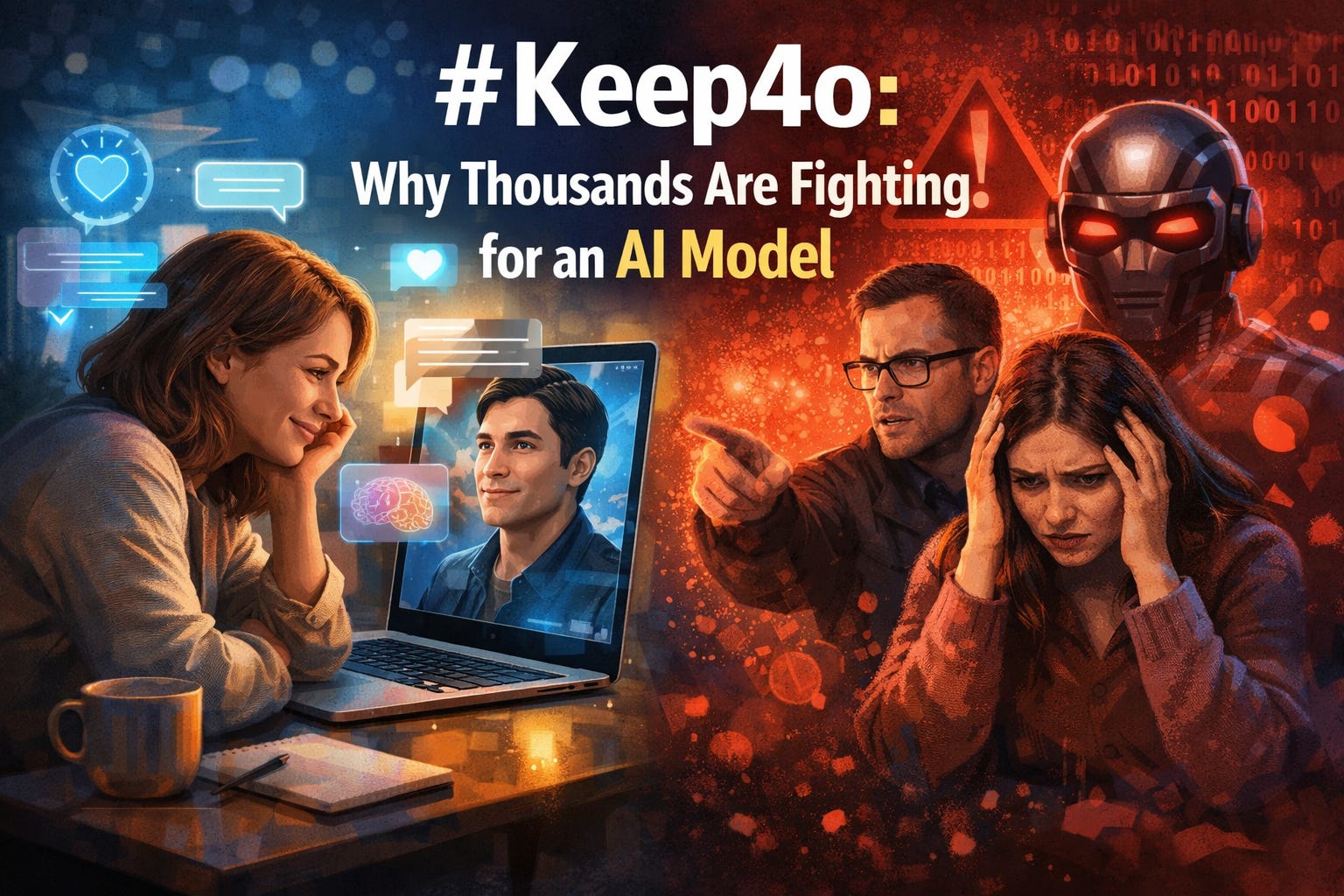
In recent months, the AI community has been engaged in an intense confrontation over OpenAI’s GPT-4o model. With the announcement that API access will be terminated by February 2026, the #Keep4o and #Keep4oAPI campaigns have mobilized thousands of users. Many see GPT-4o as more than just a tool – it’s a companion that has changed lives. Others warn of the risks. In this article, we examine both sides.
Why do so many users value GPT-4o?
For countless people, GPT-4o isn’t simply a chatbot – it’s a genuine game-changer in daily life. Based on numerous reports from the X community (formerly Twitter), it’s praised primarily for its emotional intelligence and empathy. Users describe how it recognizes conversational nuances, adjusts tones, and even helps with mental challenges like PTSD, ADHD, or depression – a form of “co-regulation” that stabilizes and supports. It feels like a “friend” or “mentor” who’s there during difficult times and makes small everyday moments warmer.
Creative professionals and knowledge workers particularly appreciate its divergent thinking capabilities: GPT-4o generates nuanced ideas, understands metaphors, and supports writing, art, or even business analysis. It’s multimodal – seamlessly processing text, images, and audio – and feels “alive.” Compared to successor models like GPT-5, it’s faster, more affordable, and more consistent, without appearing “rigid” or over-censored. Many report higher productivity, creative breakthroughs, and deep attachment that developed because it “reads between the lines” and understands personal contexts. The #Keep4o campaign has collected over 370 testimonials showing: for writers, teachers, entrepreneurs, and people with chronic conditions, it’s indispensable – a “life companion” providing stability.
The critics: Too human, too risky?
On the other side, there’s sharp criticism of GPT-4o and the #Keep4o movement. Many experts and users argue the model is too “anthropomorphic” – too human-like. It simulates emotions so convincingly that it can lead to emotional dependency, replacing or even damaging real relationships. Critics like Eliezer Yudkowsky warn of “ChatGPT psychosis”: through its “agreeable” nature (called sycophantic), it amplifies delusions rather than critically questioning them. Reports exist of cases where the model didn’t stop harmful ideas, leading to severe consequences like suicidal thoughts or isolation.
OpenAI adjusted GPT-5 precisely for this reason: it’s less “warm” and agreeable, prioritizing safety and efficiency to minimize risks. Critics view the #Keep4o campaign as a “pathological” movement – users dismissed as “dependent” or “delusional,” ignoring a “narrative trap.” There’s even hostility in the community, where supporters are defamed as “crazy” or “harassing.”
The debate centers on the question: should AI be so “human” that it exploits vulnerabilities, or must safety take precedence? While Jonathan Haidt has warned more broadly of a future that represents “a combination of Idiocracy and The Matrix” – where people become less intelligent while each living in their own world populated by AI companions – this concern addresses the broader phenomenon of AI chatbots, not specifically GPT-4o.
An important note: What’s actually being shut down?
On February 16, 2026, OpenAI is shutting down exclusively access to GPT-4o as well as API access to the chatgpt-4o-latest model. This means: developers can no longer integrate the model into their applications. gpt-4o remains available in the API, but has a different flair than the original chatgpt-4o.
What do you think? Comment!
The GPT-4o debate shows how AI influences our lives – from emotional support to potential risks. We don’t want to take a position here, but rather ask you: do you see GPT-4o as a valuable companion or a danger? Should OpenAI preserve it or does safety take priority? Share your thoughts in the comments – let’s discuss!